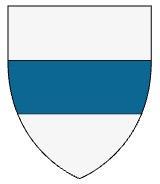
The historic arms of Charteris of Amisfield
Heraldry Basics
For a basic introduction to the language of Scottish heraldry, please see this helpful guide produced by the Clan Buchanan Society International.
Ancient Charteris Heraldry
Medieval seals suggest that the arms of Charteris of Amisfield were a fess on an otherwise plain ground. For example, one seal from c.1296 belonging to an Andrew Charteris of Amesfield shows this shield. Another seal from c.1296 belonging to Sir Thomas Charteris, knight, is similar. We can’t know what the tinctures of these arms were.
Evidence from medieval seals also shows that the arms of Charteris of Kinfauns and other Charterises based in Perthshire usually bore a tressure.
The Lyndsay Armorial of the mid 1500s records two versions of the Charteris arms. It shows one for ‘Charteris of Kinfauns’ which shows a shield argent a fess azure but has next to it ‘Hempesfelde’ crossed out. It shows another for ‘Charteris of Emisfield’ which shows a shield argent a fess a azure with a tressure gules flory counter flory and a mullet or in fess. It is possible that Lyndsay was unsure which were the Amisfield and which were the Kinfauns arms. Alternarively, the manuscript may have been altered by a later herald.
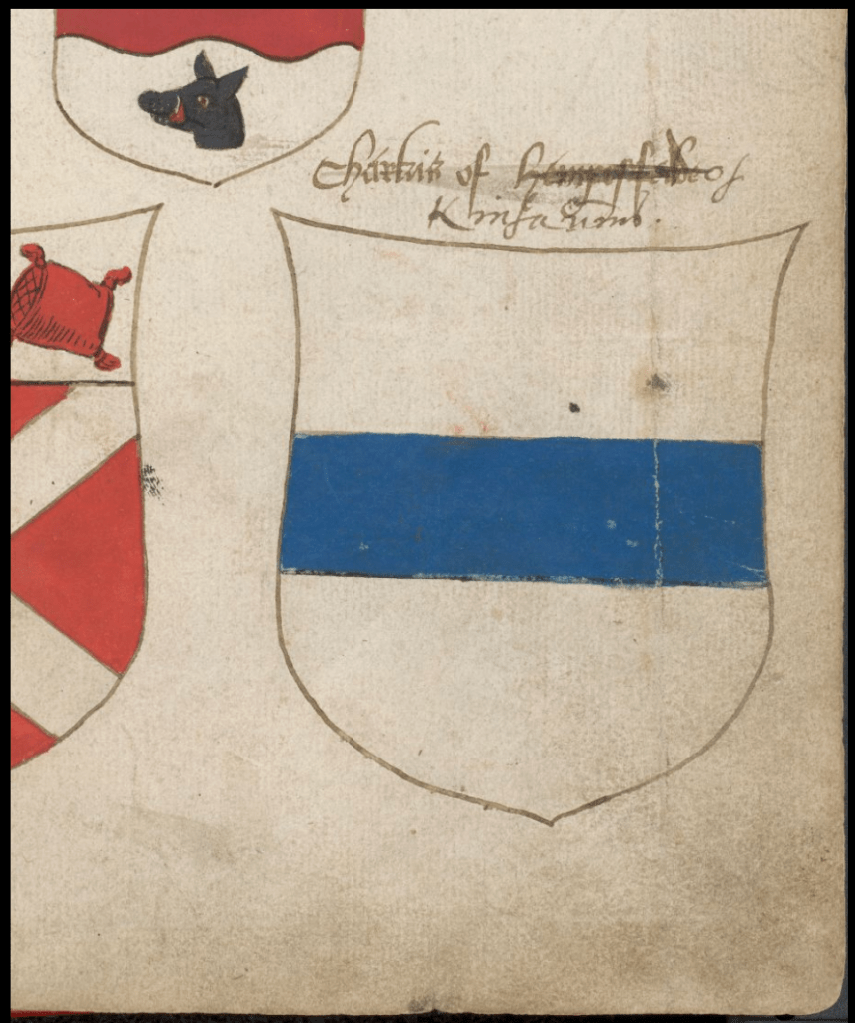
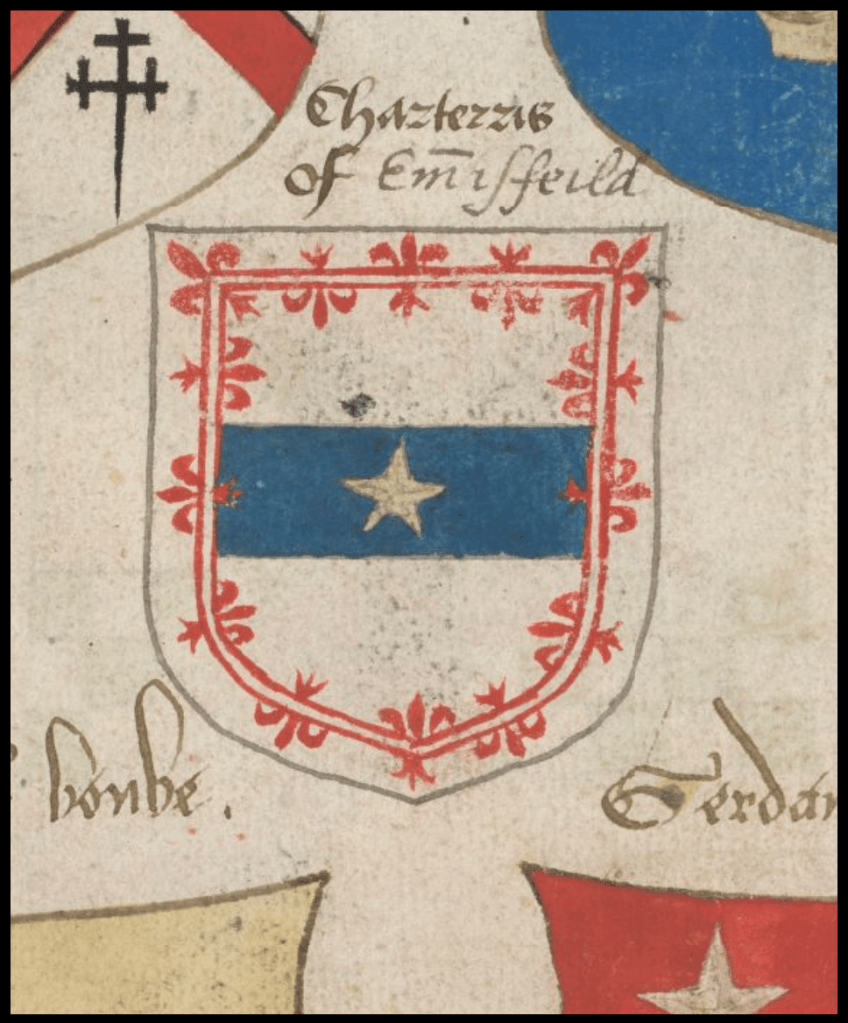
Above two images are taken from the Lyndsay Armorial created by Sir David Lindsay of the Mount, Lyon King of Arms from 1542 to 1555, National Library of Scotland,
licensed under CC BY 4.0.
It is possible that the arms shown by Lyndsay as ‘Charteris of Emisfeild’ are actually the arms of Charteris of Cuthilgurdy, a junior branch of the Charterises of Kinfauns. A 1546 seal belonging to John Charteris of Cuthilgurdy shows these arms. It is also notable that a seal of 1489 belonging to William Charteris of Kinfauns shows his crest as the head of a stork.
Charteris Heraldry 1600-1671
Around 1600, Sir John Charteris, 10th of Amisfield and his wife Agnes Maxwell, daughter of John Maxwell, 4th Lord Herries, built Amisfield Tower, near Amisfield, Dumfriesshire. This is the traditional seat of the chiefs of Clan Charteris. The tower bears two panels showing Sir John and Agnes’s respective arms. Agnes’s arms are quartered: three hedgehogs on a plain ground for Herries, her mother’s family, and a saltire with a label in chief the arms of her Maxwell father. Sir John’s arms are shown as a plain ground with a fess.
A stylised quartering of Sir John and Agnes’s arms is shown on the Amisfield Door, a carved oak door from Amisfield Tower which also bears the date ‘1600’.
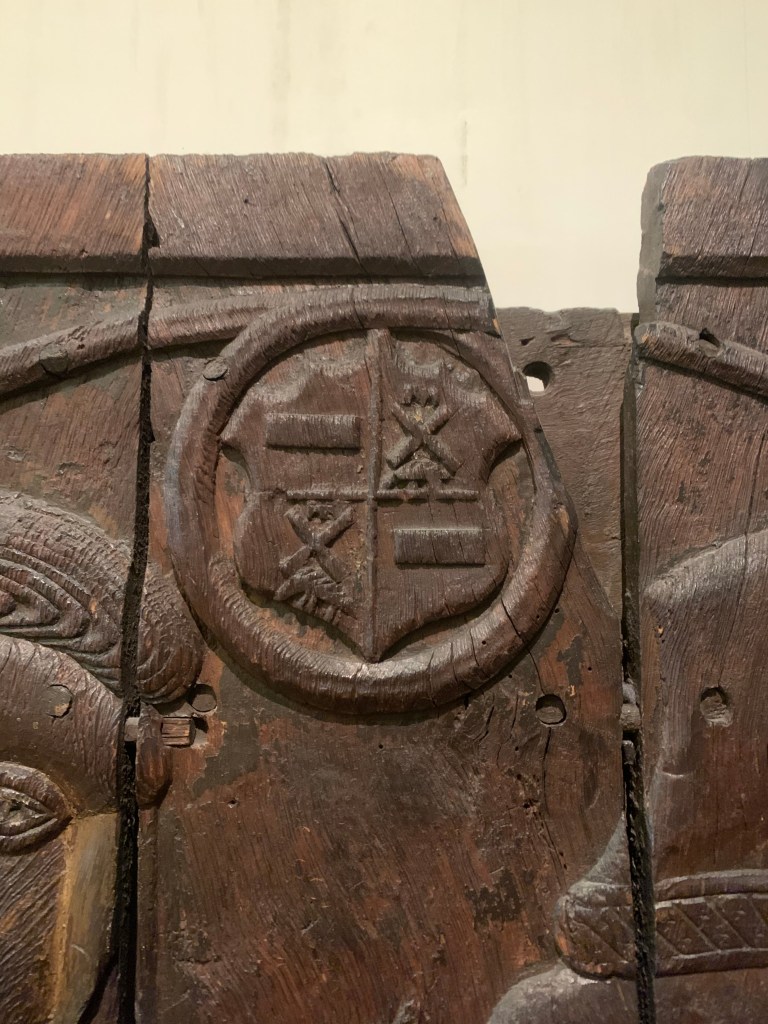
A detail of the Amisfield Door showing quartering of the arms of Sir John Charteris and Agnes Maxwell.
The north wall of the Charteris burial ground in the kirkyard at Tinwald Parish Church contains a plaque showing a plain shield with a fess, the date ‘1618’ and the initials ‘SIC’ and ‘DMF’. Probably the initials are those of Sir John Charteris, 11th of Amisfield and Dame Margaret Fleming, his wife, daughter of John Fleming, 1st Earl of Wigtown.
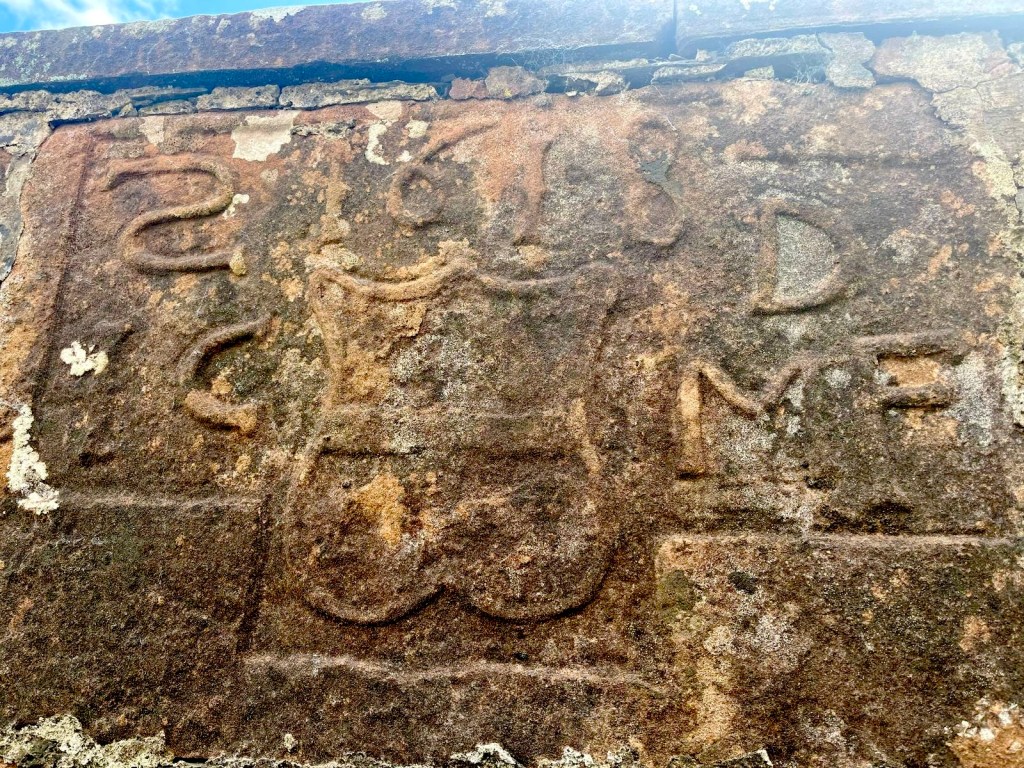
Plaque from the north wall of the Charteris burial ground at Tinwald Kirk, Dumfriesshire, showing a plain shield with a fess, the date ‘1618’ and the initials ‘SIC’ and ‘DMF’.
Charteris Heraldry Since 1672
In 1672, it became a requirement in law for all armigers to register their coats of arms with the Court of the Lord Lyon. In that year, the arms of Sir John Charteris of Amisfield were registered. They were blazoned as follows: ‘Argent, a fess azure. Above the shield ane helmet befitting his degree mantled gules doubled argent. Next is placed on ane torse for his crest an arme issuing out of a cloud holding a sword aloft proper. The motto on ane escroll Non Gladio Sed Gratia‘.
When Thomas Charteris, 13th of Amisfield, died he had no male heirs. It was generally assumed that his nephew, Colonel Francis Charteris was the ‘heir male’ of the family. Francis’s daughter became the Countess of Wemyss. In 1732, she was fined by the Lyon Court for displaying at Francis’s funeral the arms of Charteris of Kinfauns (argent a fess assure, a tressure gules flory counter flory). However, her second son Hon. Francis Charteris of Amisfield, who had adopted the name and arms of his grandfather Colonel Francis Charteris, was later able to register quartered arms incorporating the Charteris of Kinfauns arms. At the same time, he dropped the traditional crest of the Charteris family for a hand holding a dagger and the motto ‘This is our charter’. Francis was the father of the 8th Earl of Wemyss.
On 10 March 1894, Robert Charteris Thomson of Amisfield, a Canadian businessman descended from Sir John Charteris, 10th of Amisfield, was granted a version of Sir John’s arms blazoned as follows: ‘Argent a fess azure, between two mullets in chief gules and a stag’s head cabossed in base proper. Above the shield is placed a helmet befitting his degree with a mantling azure doubled argent, and upon a wreath of his liveries is set for a crest an arm in armour issuing out of a cloud, the hand holding a dagger proper, and in an escrol over the same this motto, Non gladio sed gratia‘.

