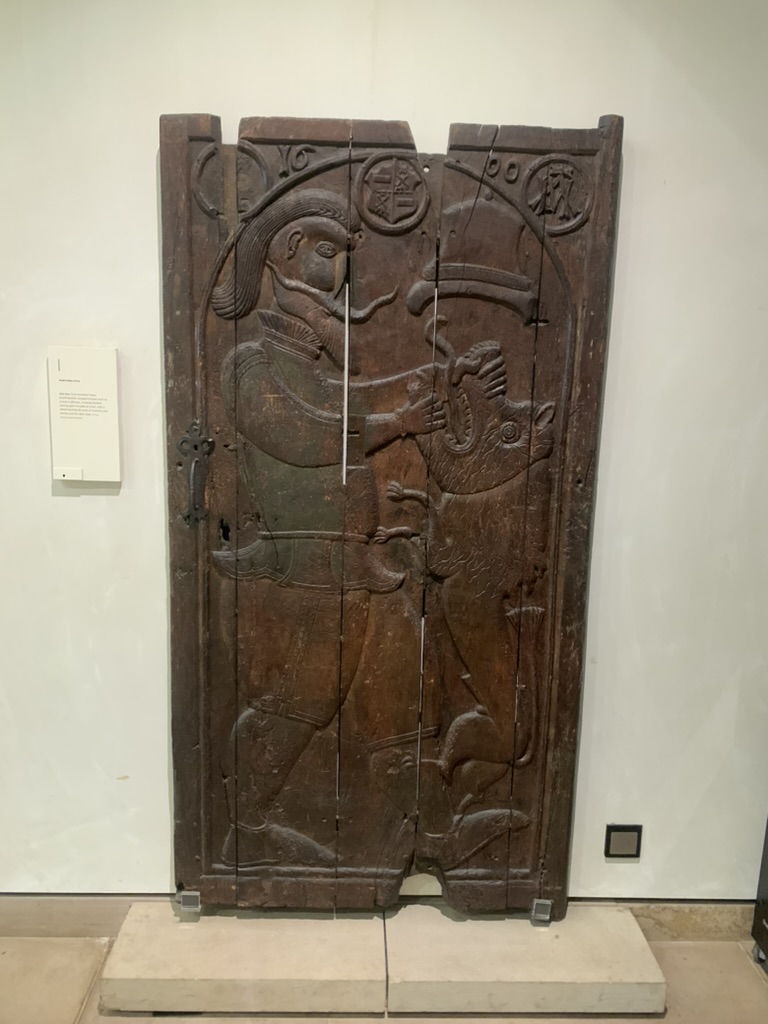
The Charteris Door in the National Museum of Scotland. Commissioned by Sir John Charteris, 10th of Amisfield and his wife Agnes Maxwell in 1600, and showing their arms quartered. It is supposed to depict Samson wrestling a lion, a metaphor perhaps for the then increasingly powerful Charteris lairds.
Introduction
The homeland of the Clan Charteris since at least the 1300s, when Sir Thomas Charteris of Amisfield was chief, has been Dumfriesshire. As we shall see, the nearness of the Charteris clan to the Border shaped our history for over half a millennium.
[NB – This history focuses on the Amisfield branch of the family, the chiefly branch. The Charterises of Kinfauns, in Perthshire, are the senior cadet line of the clan: their history will be added to this one in due course.]
The First Charterises
However, the history of the family in the Scottish Borders goes back much farther in time. One of the earliest records of the Charteris family in Scotland is a charter of 1174 to Kelso Abbey witnessed by a Robert de Carnoto. De Carnoto is the Latin form of the name Charteris; it is generally supposed that ‘de Carnoto’ indicates the Charterises, who are undoubtedly Norman, originally came from the French city of Chartes. We know the family originally had estates in Wiltshire, England. It is commonly supposed that they came to Scotland with David I, as part of what is known as the ‘Davidian Revolution’ (an interesting discussion of the Davidian Revolution can be found here).
The Wars of Independence
Andrew de Charteris signed the Ragman Roll in 1296, swearing fealty to the English king Edward I. He fought with William Wallace at the Battle of Falkirk in 1298. As a result, his lands, including ‘the castle of Amisfield and the land of Drumgree’, were forfeit and given to Guy de Beauchamp, Earl of Warwick. In 1304, Andrew de Charteris again swore allegiance to Edward.
The Charterises supported Robert the Bruce against the Comyns. William Charteris was with Bruce when he killed John Comyn in Dumfries in 1306. Robert de Charteris, Andrew’s son, must have continued the fight against Edward, because in 1314 Edward declared that the Charteris lands near Aldredstone (modern-day Whiteparish) in Wiltshire were to be escheated due to Robert’s continued rebellion.
The Charteris family apparently continued to support the Bruce monarchy into the reign of David II. A Sir Thomas Charteris was Lord High Chancellor of Scotland in David’s reign. His parentage is uncertain. He was killed at the Battle of Neville’s Cross in County Durham in 1346.
From the Bruces to Flodden
The Charterises of Amisfield were fairly quiet through the early years of the House of Stewart.
That changed in the 1480s. Robert Charteris, 6th of Amisfield, attended parliament as one of the barons of the kingdom in 1481. In 1484, James III’s brother, Alexander Stewart, Duke of Albany, and the Earl of Douglas invaded Scotland with an English army. They rode on Lochmaben, where the annual fair was taking place. The townspeople fought back against Albany and Douglas, but were quickly relieved by an army led by, among others, Robert Charteris of Amisfield. As a result, the king granted Robert the lands of Polincree in Galloway, explicitly referencing Robert’s part in resisting Albany and Douglas in the grant; the grant was confirmed again in the reign of James IV.
Robert, 6th of Amisfield, was married to Agnes, daughter of John, 4th Lord Maxwell. This is the first link between the Charterises and the Maxwells. The relationship with the Maxwells would become increasingly important.
Robert was present again for parliament in 1487, and either Robert or his grandson John Charteris, 7th of Amisfield, were present in 1506.
After Flodden
The Charteris clan were apparently one of only a few in Southern Scotland who did not lose any of their gentry at Flodden.
John Charteris, 7th of Amisfield was Sheriff Depute of Dumfries and Steward Depute of Annandale in 1525. Otherwise, the most important detail of his life is that his second son, John Charteris of Windihills and Kelwood, was lay parson of Kirkmichael and his third son Andrew Charteris was parson. The lay parson was evidently responsible for collecting what was due to the parsonage. The problem was that the local clan, the Kirkpatricks of Kirkmichael were convinced that the parsonage should rightfully be theirs, and seem to have obstructed John Charteris of Windihills in his duty. This was the start of a rather nasty feud between the Charterises and the Kirkpatricks.
The feud reached its full intensity in 1526, the year in which John, the 7th laird, died, and the 8th laird, Robert Charteris, inherited. John, 7th laird, his sons Robert and John and, confusingly, the 7th laird John’s brother Robert, were all brought before the court on 20th March. The charge was having mutilated Sir Alexander Kirkpatrick of Kirkmichael and murdered his son and heir, Robert Kirkpatrick. With them were 39 others “including Gilbert and John Greir, brothers of the Lairds of Craufurdtoun and Ile” also allegedly involved in the murder. We know they gave the court a surety for their later attendance at the Tolbooth of Edinburgh, but we don’t know what the outcome of the trial was. We do know the Kirkpatricks provided surety on 29th March to answer counter allegations by John Charteris, 7th laird. It is possible the whole thing was chalked up to the pugilistic temperament of the Borderers and they were all packed off back to Nithsdale with a stern reprimand.
Robert, 8th of Amisfield, is famous for fighting the ‘last medieval duel’ in 1530 in the presence of James V on the Esplanade of Edinburgh Castle. His opponent was James Douglas, 7th of Drumlanrig, another Dumfriesshire laird. The duel is recorded in Lindsay’s Chronicles:
“Soone efter this thair was ane singular combatt betuixt the laird of Drumlanrige, and the laird of Hempsfeild, that provockit vtheris to the barrace, for certaine poyntis of treasoun, quhilk the on alleadgit vpoun the other. So when they entered vnder the castle wall of Edinburgh, Drumlanrige being sumquhat sandblind, and being in ane furie, so meikle the ware, that he knew not quhom he hat nor quhat he hatt; bot in the meantyme Hempsfeildis sword brak, and than the king cryed over the castle wall to the heraldis and men of armes to red thame. At that tyme thair was monie southland men appailled vtheris to the singular combat, befoir the king; for ane singular combat durst not be bot in his presence, or be his consent.”
[Trans: “Soon after, there was a single combat between the Laird of Drumlanrig and the Laird of Amisfield, that provoked others to the barras [the enclosure for the duel], for certain points of treason which the one alleged upon the other. So when they entered under the castle wall of Edinburgh, Drumlanrig being somewhat sandblind, and being in a fury, so much the worse, that he knew not whom he [called?] nor what he hit; but in the meantime Amisfield’s sword broke, and then the king cried over the castle wall to the heralds and men of arms to part them. At that time there was many Borderers challenged others to the single combat, before the king; for a single combat dares not but be in his presence, or by his consent.”]
His son, John Charteris, 9th of Amisfield, married Drumlanrig’s daughter Janet. This may have been an attempt to patch up the feud between the Drumlanrig Douglases and the Charteris clan. Also in 1552, John entered into a bond of mutual protection against the Grahams along with Robert, VIth Lord Maxwell (his first cousin twice removed), Alexander Stewart, Vth of Garlies (his first cousin three times removed), James Douglas, VIIth of Drumlanrig (his fifth cousin twice removed), John Gordon, Vth of Lochinvar (his fifth cousin once removed), John Maxwell, IVth Lord Herries of Terregles (his first cousin twice removed), John Grierson, VIth of Lag (his fifth cousin twice removed) and others. On 29 October 1569, he stood surety for Alexander Charteris ‘callit Sanct Mary’ and ‘Black Jock’ Charteris on pain of 2000 marks. He must have had difficulty with the regime of Regent Moray, because in the same year he was instructed to appear within 23 hours to be warded in Falkland Castle ‘thair to remane upoun his awin expenssis’.
The First Sir John
Sir John Charteris, 10th of Amisfield made a good marriage. He married Agnes Maxwell, daughter of Johnny Maxwell, 4th Lord Herries. Johnny was a younger son of Robert Maxwell, 5th Lord Maxwell, chief of the clan. Lord Maxwell and his eldest son were frequently imprisoned in England and sometimes in Scotland. So, Johnny spent much of his young adulthood literally holding the fort at the Maxwells’ Caerlaverock Castle. Johnny was interesting as being all at once the son of a notorious reiver, a powerful local magnate and March Warden, and well connected with both the court of Mary Queen of Scots and good friends with her enemy, the reformer John Knox. He was also frequently in the pay of the English crown who wanted Caerlaverock for themselves.
The effect of this alliance on the Charterises, who already had Maxwell blood, was significant. They became embroiled in the Maxwells’ own feuds. In 1585, Sir John Johnstone was March Warden, and the Maxwells were unhappy. The previous year, there had been a bitter dispute over the election of a Johnstone as Provost of Dumfries, and the Maxwells had burned the Johnstones’ seat at Lochwood Tower and killed several of the clan. Allegedly, in the August of 1585, Maxwell had set up a gibbet in the centre of Dumfries as a threat to hang Johnstone and his followers if he wouldn’t give up Lochmaben castle to the Maxwells. At that stage, Sir John Charteris joined a raid on Johnstone lands:
“Maxwell was again proclaimed a rebel, but his half-brother, Robert, […] joined by Drumlanrig, Jardine, and Charteris made what the English Warden described as ‘a furious raid’ on the Johnstoun lands, ‘coming about 8 a.m. near to the house of Bonshaw, raised a great fire and burned the Bonshawside, and Todholes, with another farmhouse there called Dunberton, and in short they burned along the water of Dryfe, of Annan and of Milk as much as pertained to the Laird of Johnston, and committed the like outrages to all the friends and tenants of Johnston there, carrying away with them a great booty.’”
There is a tradition that the Charterises were at the Battle of Dryfe Sands in 1593, the bloody conclusion of the Johnstone-Maxwell feud. There does not appear to be any primary evidence supporting this conclusion. Nonetheless, the Johnstones’ allies the Grahams, who had already been trouble to the Maxwells and the Charterises, targeted Amisfield after the battle.
It was in 1600 that Sir John Charteris, 10th of Amisfield and Agnes Maxwell built Amisfield Tower, the traditional seat of the Charteris clan. The tower displays the arms of each of them, as does the Charteris Door, a carved oak door from the tower which is now in the National Museum of Scotland (an image of the door in the National Museum is shown at the top of this page).
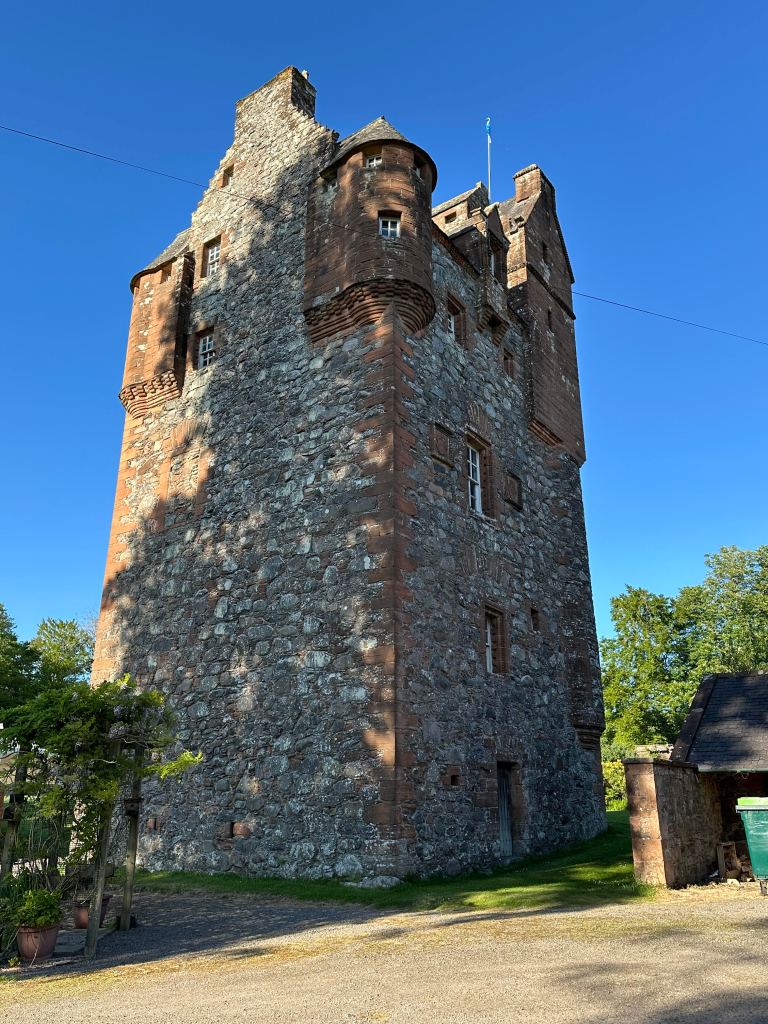
Amisfield Tower. Plaques displaying Sir John and Agnes’s arms can be seen at 2nd floor level.
The relationship with the Maxwells was not always friendly. In October 1592, English intelligence reported that Lord Maxwell intended to attack the Charterises of Amisfield and the lairds of Drumlanrig, Lochinvar, Bombie, Lagg, Closeburn and Kirkmichael. Evidently contention had been created by a large land grant by the crown to Maxwell. That grant had created problems relating to ‘the gatheringe of the comodites of the wardships casualties and other regalities within that wardenrie’. In the November, Lord Herries, Sir John’s brother-in-law, was seeking a solution to the disagreement with Lord Maxwell but ‘as yet without effect’, according to an English intelligence report. By the 10 March, the English had received information that Lord Herries and Lord Maxwell had fallen over control of 100 acres of land near Castlemilk, but had settled their differences and it was now likely Maxwell would settle his dispute with the barons, including Sir John.
Sir John Charteris, 10th of Amisfield. was a trusted servant of King James VI and I. In 1605, he was knighted and also given an enormous grant of land around Dumfries, explicitly as reward for his service as a Border Commissioner.
The Second Sir John and the Irving Feud
Sir John Charteris, 11th of Amisfield built on his father’s achievements. He took on the family estates around 1616. Douglas calls him ‘a man of great worth and fortitude’ who was ‘possessed of an immense estate’. He married Margaret Fleming, daughter of John Fleming, 1st Earl of Wigtown. This was a marriage into the highest echelons of the Scottish aristocracy: Margaret’s great-grandmother, Janet Stewart, Lady Fleming, known as ‘la Belle Écossaise’ was a natural daughter of James IV of Scotland, had been governess to Mary Queen of Scots, and had a natural son by the King of France. Janet Stewart’s daughter Mary Fleming was one of the ‘Four Marys’, the aristocratic playmates sent to France with Mary Queen of Scots. Margaret Fleming’s maternal grandfather was John Graham, 3rd Earl of Montrose.
Sir John, 11th of Amisfield, held a very wide variety of public roles. He was a Border Commissioner, Sheriff of Dumfries, substitute commissioner to supervise the General Revocation of land grants, a commissioner for inspecting the highway, was part of a commission deciding economic questions for the king, and was given a commission to prevent the illegal export of cattle.
Some of his commissions were less savoury. Sir John was several times asked to apprehend Catholics, and was also the judge at several witch trials.
During the time of Sir John, 11th of Amisfield, the Charterises engaged in a running feud with the Irvings. In 1626, Sir John was instructed to seize to Stapleton Tower, which the Irvings had taken by force from Fergus Graham of Blaetwood. He was accompanied by Grierson of Lag and Maxwell of Kirkonnell. The attempt turned into a lengthy seige, and Sir John returned later with a much larger force including many of the leading nobles of the area.
Trouble with the Irvings did not end there.
On 14 February 1628, a commission was given to the Steward of Annandale, with Sir William Grierson of Lag, Lag’s son, James Maxwell of Tinwald, Robert Charteris of Kelwood, and Archibald Johnstone of Elshieshields to apprehend Jaffray Irwing and his sons Hobbie Irwing and John ‘Brunt Willeis’ Irwing, all in Middle Schaw, who had been put to the horn on 6 February for murdering Robert Charteris, servant to Sir John Charteris.
On 29 July 1628, Sir John and Sir William Grierson of Lag were given a commission by the Privy Council of Scotland to try George Irwing in Mospibill, who had been caught ‘with the bloodie hand’ following the murder of Robert Bell the previous May.
On 18 December 1628, a number of leading noblemen wrote to the king. They had heard that the king was displeased with Sir John Charteris because Sir John had killed several persons of the name of ‘Irwin’ upon ‘the marches of the border of your Majesteis kingdome of England’. The signatories to the letter were William Graham, Earl of Mentieth, Thomas Hamilton, Earl of Haddington, Alexander Livingston, Earl of Linlithgow, Walter Scott, Earl of Buccleuch, Alexander Stewart, Earl of Galloway, Archibald Campbell, Lord Lorne (later 8th Earl and 1st Marquess of Argyll), ‘Dumblane’ (possibly Adam Bellenden, Bishop of Dunblane), Archibald Aitcheson, (later Sir Archibald Aitcheson of Glencairn), Sir Thomas Hope of Craighall and Sir John Scott of Scottistarvet.
The signatories called Sir John before themselves to give an account of his actions and ‘put him under restraint’ until he could do so. He informed them, in short, that he had been doing his duty as a Justice of the Peace and a Commissioner for the Middle Shires. The Irwins were suspected of theft; he had tried to apprehend them but a ‘near kinsman’ had been killed by them in the process. Presumably this ‘near kinsman’ was his servant Robert Charteris. The Irwins had been summoned in relation to the killing, but had not appeared; finally they were ‘put to the horn’ (i.e. outlawed). A special commission had then been given to Sir John Charteris to apprehend them.
He pursued them, discovering them close to the border. They rode across the border to escape him, but Sir John followed them into England. When they could no longer escape, the Irwins had turned on Sir John and his company, firing pistols at them. Sir John evidently returned fire, and the Irwins ‘wer both so wounded in the taking as they died beyond the expectatioun or desyre of the said Sir Johne Charterhouse’.
The Third Sir John and the Wars of the Three Kingdoms
Sir John, 12th of Amisfield made another good marriage: he married Catherine Crichton, daughter of William Crichton, 1st Earl of Dumfries. While still heir of Amisfield, he was made a Justice of the Peace of Dumfries.
Sir John was a covenanter. He was one of the Commissioners of Parliament who confirmed the Treaty of Ripon between the Scottish covenanters and Charles I. In 1643, he was a member of the Privy Council of Scotland. He was known to be a royalist, however, and was imprisoned between 1643 and 1645. He was released upon providing caution of 20,000 merks and upon James Murray, Earl of Annandale, James Johnstone, Lord Johnstone, Sir Robert Grierson of Lag and Alexander Jardine of Applegrarth acting jointly and severally as cautioners for him. However, he was required to stay within six miles of Edinburgh. He fled to join the army of his cousin, the Marquis of Montrose. He led a scout detachment which observed the movements of General Leslie’s army before the Battle of Philiphaugh in 1645.

